Engine Oil Change
Engine Oil Change in Romford – Oil & Filter Change Service
Engine oil isn’t something most drivers think about every time they start their car. When the level is right and the oil is doing its job, there’s usually nothing to notice.
But that doesn’t make it unimportant.
Oil works inside your engine every time it runs. It lubricates moving components, helps manage heat and reduces unwanted friction between parts. As the miles build up, the oil doesn’t remain in the same condition forever. That’s why changing it at the appropriate interval is a basic but important part of looking after your vehicle.
At Tyre Shop Near Me, we provide engine oil changes in Romford for local motorists who want straightforward vehicle maintenance without unnecessary complications.
An oil change isn’t about simply pouring fresh oil into the engine. The correct oil specification matters, the oil filter needs consideration, and the vehicle should receive the quantity appropriate for its engine.
Not sure when yours was last changed?
Tell us your vehicle registration, make and model. We can help you work out the appropriate next step.
Our local service is convenient for motorists in Romford as well as drivers travelling from Gidea Park, Collier Row, Rush Green, Hornchurch, Harold Wood and surrounding parts of Havering.
Local Oil Change Service in Romford
There are plenty of reasons why someone might need an oil change.
Perhaps your service is due.
Maybe you’ve recently bought a used car and want to start your maintenance from a known point. Your dashboard may be showing a service reminder, or you’ve checked the maintenance history and realised the oil hasn’t been changed for some time.
Some drivers simply know they’ve covered a lot of miles since the last service.
Whatever brought you here, the important thing is not to treat every vehicle exactly the same.
Different engines can require different oils. Service intervals can also vary according to the manufacturer, engine, age of the vehicle and how it’s used.
That’s why our oil change service in Romford starts with the vehicle rather than a one-size-fits-all bottle of oil.
What Does Engine Oil Actually Do?
Inside an engine, many components are moving at high speed.
Those parts need lubrication.
Engine oil creates a protective film between moving surfaces, helping reduce friction and wear. It also plays a part in managing heat and carrying contaminants towards the filter.
Think of it as one of the fluids your engine depends on every time you drive.
The oil has to cope with repeated heating and cooling as well.
You start the engine on a cold morning, drive through Romford, sit in traffic, join a faster road and eventually park. The engine goes from cold to operating temperature and later cools again.
That cycle happens over and over.
Eventually, the oil needs replacing.
Why Does Engine Oil Need Changing?
Fresh engine oil doesn’t stay fresh indefinitely.
It works in a demanding environment.
Over time and mileage, its condition can deteriorate and contaminants can accumulate. That’s one reason manufacturers specify maintenance schedules rather than expecting the same oil to remain in an engine forever.
Changing the oil at an appropriate interval helps keep the lubrication system supplied with oil that meets the engine’s requirements.
It’s a relatively routine maintenance job, but one that shouldn’t be overlooked.
Waiting indefinitely because “the car still drives fine” isn’t a maintenance plan.
If you aren’t sure when your oil was last changed, check the vehicle’s service records or speak to us about arranging an inspection and oil service.
Engine Oil and Filter Change in Romford
An oil change and an oil filter change naturally belong together.
The filter’s job is to capture contaminants circulating with the engine oil.
Leaving an old filter in place while replacing the oil may not make sense when the vehicle is due for a normal oil-and-filter service.
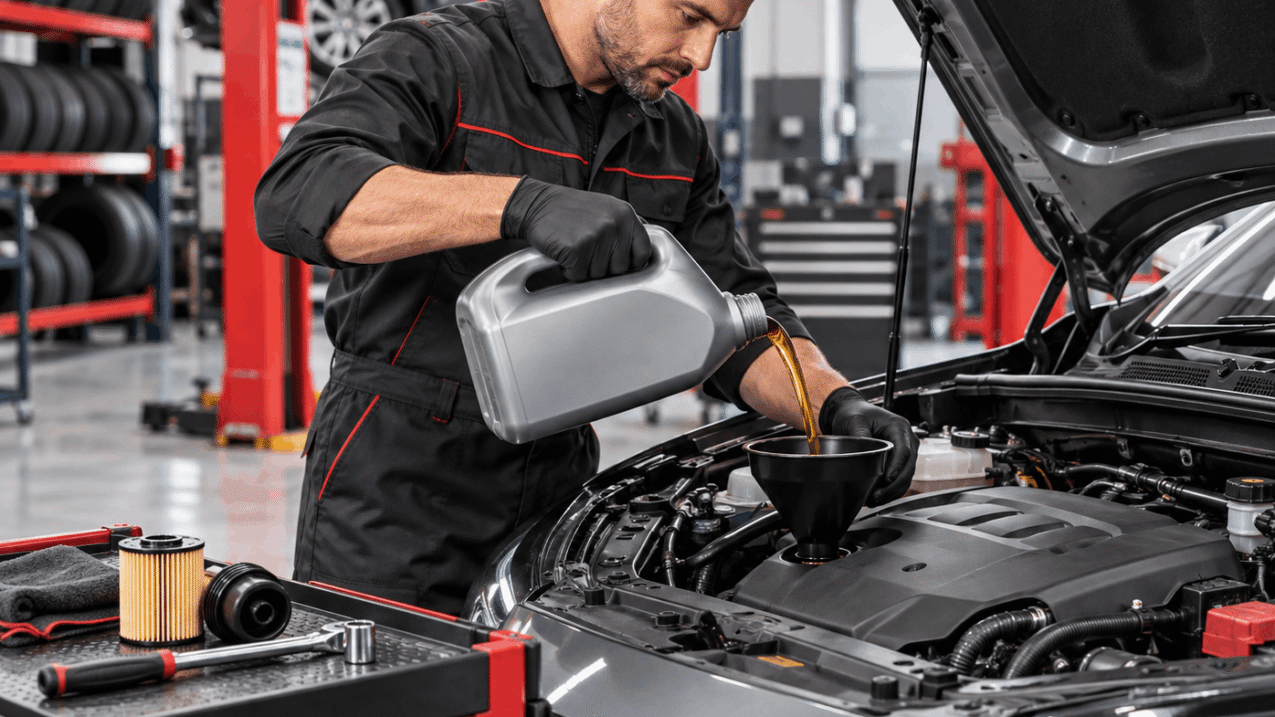
During an oil and filter change in Romford, the old engine oil is drained and replaced with fresh oil of an appropriate specification. The oil filter is also replaced where included as part of the service.
The exact process and quantities depend on the vehicle.
That’s why your registration details are useful when booking.
Why Is the Oil Filter Important?
The filter is easy to forget because you don’t normally see it.
But it performs an important job.
As oil circulates through the engine, the filter helps remove unwanted particles and contaminants before the oil continues through the lubrication system.
Like most filters, it has a working life.
This is why you’ll often hear garages refer to an oil and filter change rather than simply an oil change.
When you contact us, tell us whether you’re looking for a straightforward oil-and-filter service or a broader vehicle service.
We can then discuss the appropriate option.
How Often Should I Change My Engine Oil?
This is one of the most common questions we hear, and the correct answer isn’t one fixed mileage for every car.
Your manufacturer’s servicing schedule should be the starting point.
Some vehicles have fixed service intervals. Others may use variable servicing systems that consider how the vehicle has been driven.
The engine and oil specification matter too.
How you use the vehicle can also make a difference.
A car used mainly for short urban journeys has a different life from one covering long motorway distances regularly.
Rather than relying on a generic rule you found online, check the maintenance information for your particular vehicle.
If you’re unsure, give us your registration and we’ll help you work out what type of service you need.
What Happens During an Engine Oil Change?
The basic idea is simple: old oil comes out and fresh oil goes in.
The actual job needs a little more care than that.
The vehicle needs to be handled safely, the existing oil drained appropriately and the correct replacement oil selected.
Where an oil filter change is included, the old filter is removed and a suitable replacement fitted.
The correct amount of fresh engine oil is then added.
The oil level needs to be checked rather than guessed.
Relevant areas can also be inspected for obvious signs of leakage during the process.
The details differ between vehicles, but the objective remains the same: replace the used oil with the correct fresh oil and ensure the level is appropriate.
Choosing the Correct Engine Oil
Walk into an automotive shop and you’ll see shelves full of oils.
5W-30. 0W-20. 5W-40.
Then there are manufacturer specifications and approvals to consider.
It’s understandable if those numbers don’t mean much to you.
You don’t need to become an oil expert just to maintain your car.
What matters is using oil that meets the requirements specified for the engine.
Two vehicles parked next to each other can require different products even if they’re similar in age.
We therefore don’t recommend choosing oil based solely on whichever bottle is cheapest or happens to be available.
When booking your car oil change in Romford, provide your vehicle registration so the correct requirements can be identified.
What Do Numbers Like 5W-30 Mean?
Engine oil labels normally include a viscosity grade.
A common example is 5W-30.
You’ll see other grades too, depending on the engine.
These numbers describe how the oil behaves under different temperature conditions. However, viscosity grade isn’t the only thing that determines whether an oil is suitable.
Manufacturer specifications and approvals can also matter.
So seeing the same viscosity number on two bottles doesn’t necessarily mean they’re interchangeable for every vehicle.
Follow the requirements for your particular engine.
Synthetic, Semi-Synthetic or Conventional Oil?
You may also come across terms such as synthetic and semi-synthetic oil.
Modern engines often have quite specific lubrication requirements, and the right choice should be based on what the vehicle manufacturer specifies rather than assuming one broad category works for every car.
The simplest approach is not to choose by marketing terminology alone.
Identify the correct specification first.
Then use an oil that meets it.
If you’re uncertain, that’s something we can help with when arranging your engine oil service in Romford.
What Happens If I Don’t Change My Oil?
Skipping an oil change once doesn’t mean an engine will immediately stop working.
That’s partly why maintenance gets postponed.
The car starts today. It started yesterday. So it can be tempting to leave servicing for another month.
Then another.
But engine oil is there to protect moving components under demanding conditions. Allowing oil to remain in use well beyond the appropriate maintenance interval isn’t a good way to look after an engine.
Regular maintenance is generally far easier to plan than dealing with engine problems later.
If your oil change is overdue, don’t panic.
Just get the maintenance back on track.
How Do I Check My Engine Oil Level?
Many cars still use a traditional dipstick, although some newer vehicles use electronic oil-level monitoring.
If your vehicle has a dipstick, park safely on level ground and follow the manufacturer’s procedure for checking the level.
The exact procedure can vary.
Generally, you’re looking to confirm that the oil level sits within the indicated acceptable range rather than below the minimum or above the maximum.
If your car uses an electronic measurement system, follow the instructions displayed by the vehicle or in the handbook.
Don’t guess if you’re unsure.
Adding too much oil isn’t a sensible solution to being uncertain about the level.
What Does the Engine Oil Warning Light Mean?
This is important.
An oil warning light shouldn’t simply be treated like a reminder to book a routine oil change at some point next month.
Depending on the vehicle and warning displayed, it can indicate an issue requiring prompt attention.
A red oil-pressure warning can be particularly serious.
If an oil-pressure warning appears while driving, follow the manufacturer’s guidance and don’t assume that topping up the oil automatically fixes the underlying problem.
A service reminder and an oil-pressure warning are not necessarily the same thing.
If you don’t understand what your dashboard is telling you, get appropriate advice rather than continuing to drive and hoping the light disappears.
Why Is My Engine Oil Level Low?
Engines can lose or consume oil for different reasons.
Sometimes the level is simply lower because it hasn’t been checked for a long time.
In other situations, there may be a leak or the engine may be consuming oil.
If you’re repeatedly adding oil between services, tell us.
That’s useful information.
Simply topping it up every few weeks without asking where the oil is going can hide an issue that deserves investigation.
The same applies if you’ve noticed oil underneath the parked vehicle or around the engine bay.
Is My Car Leaking Engine Oil?
An oil mark on the driveway gets your attention quickly.
But not every liquid underneath a car is engine oil.
Vehicles contain several different fluids, and water from the air-conditioning system can also appear underneath a car in normal operation.
Engine oil is generally oily to the touch and can range considerably in colour depending on its age and condition.
Rather than trying to diagnose the leak from the stain alone, arrange an inspection if you suspect the vehicle is losing oil.
The source needs to be identified.
Adding more oil may maintain the level temporarily, but it doesn’t repair a leak.
Why Does My Oil Look Dark?
Drivers sometimes become concerned when fresh-looking oil turns dark.
Colour alone doesn’t tell you everything about the condition of engine oil.
Oil works inside an engine and is exposed to contaminants and heat. It can change appearance as it does its job.
So don’t decide whether your oil needs changing solely by looking at its colour.
Service history, mileage, time and the manufacturer’s maintenance requirements provide much more useful information.
If you don’t know when it was last changed, that’s a better reason to investigate.
Oil Change or Full Service – Which Do I Need?
These aren’t necessarily the same job.
An engine oil and filter change focuses mainly on replacing the engine oil and oil filter.
A broader vehicle service normally includes additional inspections and maintenance items, with the exact work depending on the service level and vehicle.
If all you need is routine oil and filter maintenance, an oil-change service may be appropriate.
If the vehicle is due for its scheduled service, simply changing the oil may not cover everything required.
Check the service history.
If you’re unsure, tell us when the vehicle was last serviced and what work was completed.
We can help you decide which option makes more sense.
Oil Changes for Petrol Cars
Petrol engines still need the correct engine oil.
The required viscosity and specifications vary between manufacturers and engines.
Don’t assume that because you’ve used a particular oil in one petrol car, the same bottle should go into another.
Modern petrol engines can have very specific oil requirements.
Give us your registration when booking so the correct specification can be considered.
Oil Changes for Diesel Cars
Diesel engines also require oil appropriate to their design and manufacturer requirements.
Some modern diesel vehicles have emissions-control systems that make using the correct specification particularly important.
Again, don’t choose based on viscosity alone.
If you drive a diesel vehicle in Romford and need an oil and filter change, provide the vehicle details when you contact us.
We’ll use them to identify the appropriate requirements.
Oil Changes for Hybrid Vehicles
Owning a hybrid doesn’t mean you can forget about engine oil.
If the vehicle has an internal combustion engine, that engine still requires appropriate lubrication and maintenance.
The maintenance schedule should be followed according to the manufacturer’s recommendations.
Hybrid vehicles can also have model-specific requirements, so correct identification of the vehicle matters.
If you’re unsure what maintenance your hybrid needs, start with its service schedule and registration details.
High-Mileage Cars and Engine Oil
Older or higher-mileage vehicles deserve proper maintenance just as much as newer cars.
In fact, keeping on top of fluid levels and service intervals can become even more important as a vehicle ages.
If you’ve recently bought a used car with incomplete maintenance history, an oil and filter change may be one of the jobs you consider as part of establishing a fresh maintenance baseline.
However, don’t automatically pour thicker oil into an older engine because someone online said it was a good idea.
Use a specification appropriate for the vehicle unless there’s a sound technical reason to do otherwise.
I Only Drive Short Distances – Do I Still Need Oil Changes?
Yes, low annual mileage doesn’t automatically mean engine oil can remain in the vehicle indefinitely.
Time matters as well as mileage.
Short journeys can also create their own operating conditions because the engine may spend more time warming up and may not always reach full operating temperature for long periods.
Follow the manufacturer’s servicing requirements even if you don’t cover many miles each year.
This is particularly relevant for cars used mainly for short trips around Romford, school runs or local shopping.
I Drive Lots of Miles – Should I Check My Oil More Often?
If you cover substantial mileage, keeping an eye on the oil level is sensible.
Don’t wait until the next service to discover the engine has been running low.
Long-distance commuters, business drivers and motorists covering frequent motorway journeys may reach mileage-based maintenance points sooner than low-mileage drivers.
Check the service schedule and monitor the level according to your vehicle’s requirements.
Engine Oil Change Before a Long Journey
Planning a long drive?
Your engine oil is one of several basic checks worth considering before setting off.
Look at the service history first.
If the vehicle is already overdue for maintenance, dealing with it before a long journey makes more sense than putting it off until you return.
Also check the oil level according to the vehicle manufacturer’s procedure.
Tyre pressures, tyre condition, coolant and other basic maintenance items deserve attention too.
The goal isn’t to replace everything before every motorway trip.
It’s simply to avoid starting a long journey with maintenance you already know is overdue.
Can I Just Top Up the Oil Instead of Changing It?
Topping up and changing the oil serve different purposes.
If the oil level is below where it should be and the correct oil is required, topping up may restore the level.
But adding a little fresh oil doesn’t remove the existing used oil or replace the oil filter.
So repeatedly topping up shouldn’t be treated as an alternative to scheduled maintenance.
Think of the oil level and oil-change interval as two separate things.
Both matter.
What If I Put the Wrong Oil in My Car?
If you realise you’ve added the wrong oil, don’t simply assume it will be fine.
What you should do depends on what was added, how much was added and whether the engine has been run.
Get advice based on the specific vehicle and product involved.
The easiest way to avoid this situation is to identify the required oil before adding anything.
If you’re standing in front of several bottles and aren’t sure which one your engine needs, don’t guess from the label design.
Check the manufacturer’s specification.
Can Too Much Engine Oil Cause Problems?
Yes, more isn’t automatically better.
Engine oil should be maintained at the appropriate level.
If you accidentally overfill the engine significantly, get advice rather than assuming the excess will somehow disappear harmlessly.
This is why checking the level properly during an oil change matters.
The aim isn’t to fill the engine “as much as possible”.
It’s to use the appropriate quantity and confirm the level correctly.
Why Is My Car Asking for an Oil Change?
Many modern cars display maintenance reminders.
These may be based on mileage, time or more sophisticated service-monitoring systems depending on the vehicle.
If a service or oil-change message appears, check what it means for your particular model.
Don’t confuse a routine service notification with an urgent warning relating to oil pressure or another fault.
If you’re unsure, tell us exactly what the dashboard displays.
A photo of the message can also be useful when asking for advice.
Engine Oil Change and Your Service History
Keeping maintenance records is worthwhile.
Whether you use a physical service book, invoices or a digital service record, having evidence of routine maintenance helps you understand what has already been done and when future work may be due.
It can also be useful when you eventually sell the vehicle.
After an oil change or service, keep the relevant record with the rest of your vehicle documentation.
A folder of receipts isn’t exciting, but it can save plenty of confusion later.
Engine Oil Change for Cars and Vans in Romford
Different vehicles have different oil capacities and specifications.
A small petrol hatchback doesn’t necessarily require the same product or quantity as a diesel van.
That’s why vehicle identification is important when requesting a quote.
If you’re contacting us about a van, tell us the registration and model just as you would for a car.
We can then discuss the appropriate oil-and-filter service for that particular vehicle.
Oil Change After Buying a Used Car
You’ve just bought a used car.
It drives well, but the service history is unclear.
When was the oil actually changed?
If there’s reliable documentation, great.
If nobody can tell you, establishing a maintenance baseline may be sensible.
That doesn’t mean replacing every fluid and component blindly.
Start by reviewing whatever history is available, checking the manufacturer’s schedule and assessing what maintenance is genuinely due.
An engine oil and filter change may be part of that process.
Local Engine Oil Change in Romford
Convenience matters with routine maintenance.
If getting an oil change involves travelling a long distance, it’s easier to keep postponing it.
Our local oil change service in Romford gives drivers a nearby option for routine engine maintenance.
Whether you use your vehicle for commuting, family journeys, deliveries, school runs or occasional weekend trips, keeping on top of basic maintenance can save uncertainty later.
You don’t need to know your exact oil specification before contacting us.
Start with the registration.
Oil Change Near Gidea Park
If you live or work around Gidea Park and your vehicle is due for an oil and filter change, our Romford service is conveniently located for local maintenance.
Have your registration ready when enquiring.
If you know when the oil was last changed, tell us that too.
Engine Oil Change Near Collier Row
Drivers from Collier Row can also contact us for routine oil-change services.
Whether you’ve reached the next service interval or simply don’t know when the oil was last replaced, we can help you work out the next step.
Oil Change Near Rush Green
We’re also convenient for motorists around Rush Green.
If your dashboard is showing a service reminder or you’re due an oil-and-filter change, contact our Romford team with your vehicle details.
Engine Oil Service Near Hornchurch
Drivers travelling from Hornchurch can use our Romford service for routine engine oil maintenance.
Tell us your vehicle registration and whether you’re looking for an oil-and-filter change or a more comprehensive service.
Oil Change Near Harold Wood
If you’re based around Harold Wood and searching for an engine oil change near me, our Romford garage provides a convenient local option.
Don’t worry if you’re unsure what grade your car takes.
Provide the vehicle details and we’ll start from there.
Why Choose Us for an Engine Oil Change in Romford?
We keep routine vehicle maintenance straightforward.
You shouldn’t have to stand at a parts counter trying to work out which of twenty different oil bottles belongs in your engine.
Vehicle-Specific Approach
We start with your vehicle details because different engines have different requirements.
Correct Oil Matters
We focus on identifying oil appropriate to the engine rather than treating all vehicles the same.
Oil and Filter Service
Where appropriate, the engine oil and oil filter can be dealt with together as part of routine maintenance.
Local Romford Garage
Our service is aimed at motorists in Romford and surrounding parts of Havering.
Straightforward Advice
If an oil change isn’t the same thing as the service your vehicle actually needs, we’ll explain the difference.
Broader Vehicle Maintenance
Because we also work with tyres and other vehicle services, you can deal with several routine maintenance needs through one local garage.
Book an Engine Oil Change in Romford
If your engine oil change is due, don’t keep moving it to next month’s to-do list.
Contact Tyre Shop Near Me and tell us what you drive.
Your registration is usually the best place to start.
If you know your current mileage and when the vehicle was last serviced, have those details ready too.
You can also tell us whether you’ve noticed anything unusual, such as an oil warning, low oil level or signs of a leak.
We’ll help determine whether you’re looking for a straightforward engine oil and filter change in Romford or whether a broader service would be more appropriate.
Get in touch with our local team to arrange your oil change.